How to Spy on Your Competitors' Instagram Accounts: A 7-Step Guide

On this page
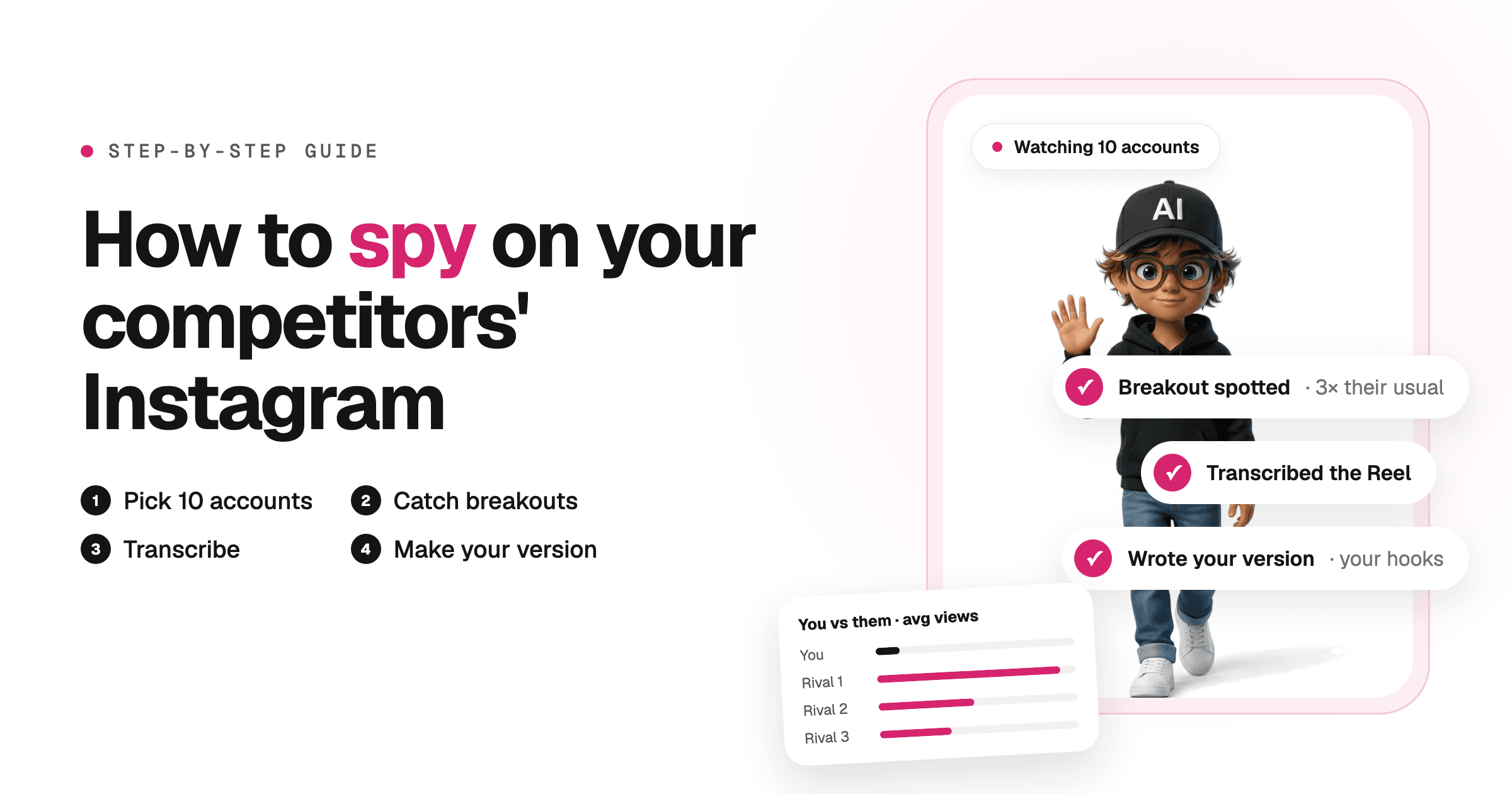
To spy on your competitors' Instagram, pick up to 10 accounts in your niche, compare their followers, views, engagement and posting rate with yours, and watch for breakout posts: the ones that did at least twice that account's usual views. Then transcribe the winners, find the pattern behind them, and make your own version for your audience. An AI agent can run all of it for you every week.
"Spying" sounds sneaky. It isn't. Every post your competitors publish is a public experiment, paid for with their time, and the results (views, likes, comments) are printed right under it. Most people scroll past that free research. In this guide we'll go on a small mission instead: seven stops, from knowing where you stand today to publishing a post built on what's already proven to work in your niche. I'll show you how I do it on my own account with the Talk to me Data social media agent, using my real numbers, plus the free manual version if you'd rather do it by hand.
Why Should You Spy on Your Competitors' Instagram?
Because it's the fastest way to find out what your audience wants without guessing. Your competitors post to the same people you want to reach. Every Reel that flops and every carousel that takes off is a test result you get for free. Starting from a blank page every week means ignoring all of that data and paying for the same lessons yourself, one slow post at a time.
This is the idea I keep coming back to: don't reinvent the wheel. Nobody builds a business by inventing a new format every week. They spot what's already working, understand why, and do their own version better or for a more specific audience. On Instagram, trends also move fast. A hook style or format can carry a niche for a few weeks and then fade. If you're watching the right accounts, you catch it while it's rising instead of after everyone is tired of it.
Here's the route we'll take:
Know Your Own Baseline Before You Spy
Before you look at anyone else, you need your own numbers: your usual views per post, your engagement rate, your best format and how often you post. Without them, a competitor's results are just big numbers. With them, you can see exactly where the gap is.
The quickest way is our free social media page analyzer. Paste your Instagram handle and you get a one-page snapshot of your account by email: what's working, what to fix and what to try next. It's the "you are here" pin on the map. If you already use the social media agent, the Overview tab gives you the same baseline and keeps it updated.
How Do You Find the Right Competitors to Track on Instagram?
You find the right competitors by looking for accounts that post content like yours to people like yours, not just accounts in the same industry. A bakery's real Instagram competitors might be food creators, not the bakery down the road. Pick two kinds:
The social media agent does the searching for you. It reads your bio and captions to understand your niche, then suggests accounts that post similar content, each with a short description and a preview of their recent posts and views. Here are the suggestions it gave me for my own account, @sellingwithnas, where I post about AI agents:
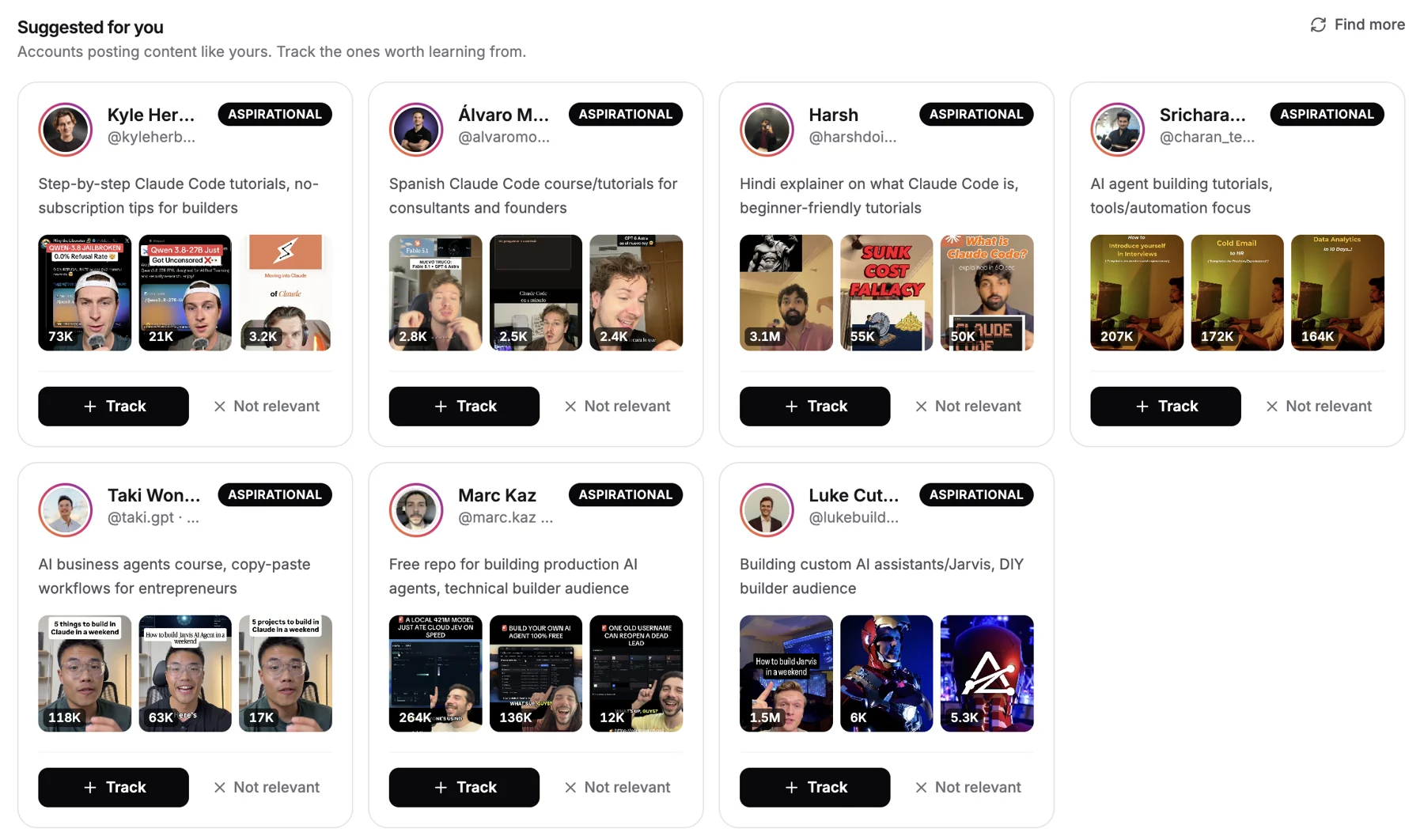
You click Track on the useful ones and Not relevant on the rest, and the agent learns from both. Find more pulls another batch. You can also paste any account's link to add it directly.
How many should you track? The agent can spy on up to 10 accounts at any given time. That's the sweet spot: enough to tell a real trend from one lucky post, few enough that every account earns its place. If one stops being useful, remove it and track someone new.
What Instagram Metrics Should You Track on Competitors?
Track five public numbers per account: followers, average views, engagement rate, posts per week and top format. Together they tell you how big each account is, how much attention each post gets, how hard the audience reacts, how much effort they put in and what they bet on. The agent puts them side by side with yours in one You vs them table, averaged over each account's recent posts.
This is my real scoreboard from this week, next to three of the accounts I track:
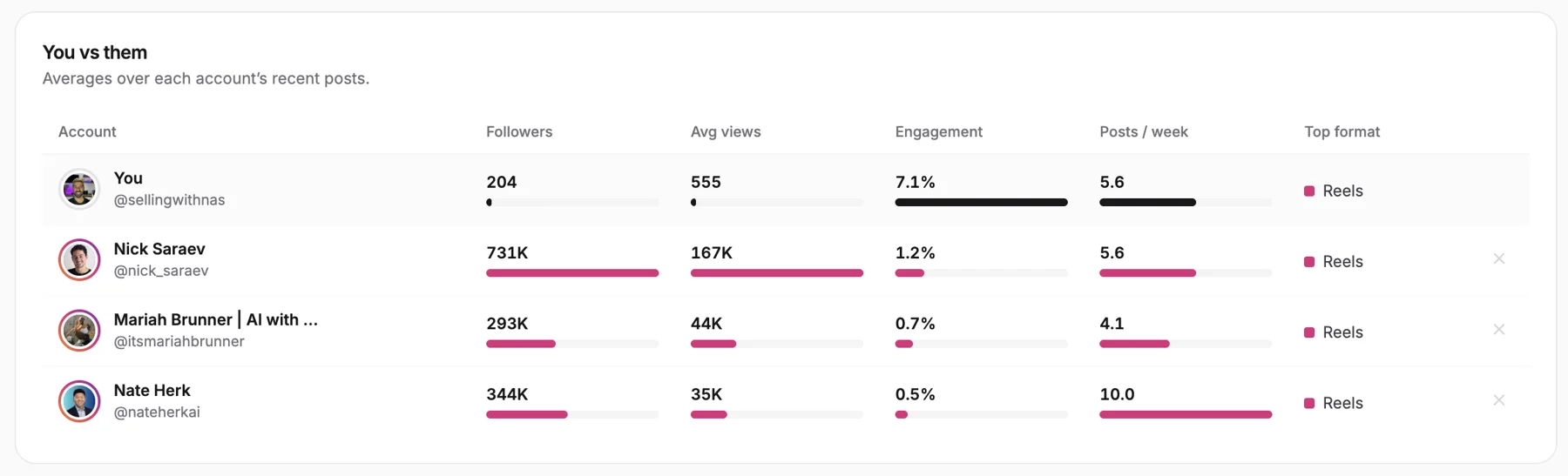
| Account | Followers | Avg views | Views per follower | Engagement | Posts / week |
|---|---|---|---|---|---|
| Me (@sellingwithnas) | 204 | 555 | 2.7 | 7.1% | 5.6 |
| Nick Saraev | 731K | 167K | 0.23 | 1.2% | 5.6 |
| Mariah Brunner | 293K | 44K | 0.15 | 0.7% | 4.1 |
| Nate Herk | 344K | 35K | 0.10 | 0.5% | 10.0 |
Views per follower is my own calculation (average views divided by followers). Every other number is from the agent's You vs them table on 15 November 2026. All four accounts' top format is Reels.
Here's what I read from it, and it's the kind of thing you should look for in yours:
How Do You Find Your Competitors' Breakout Posts?
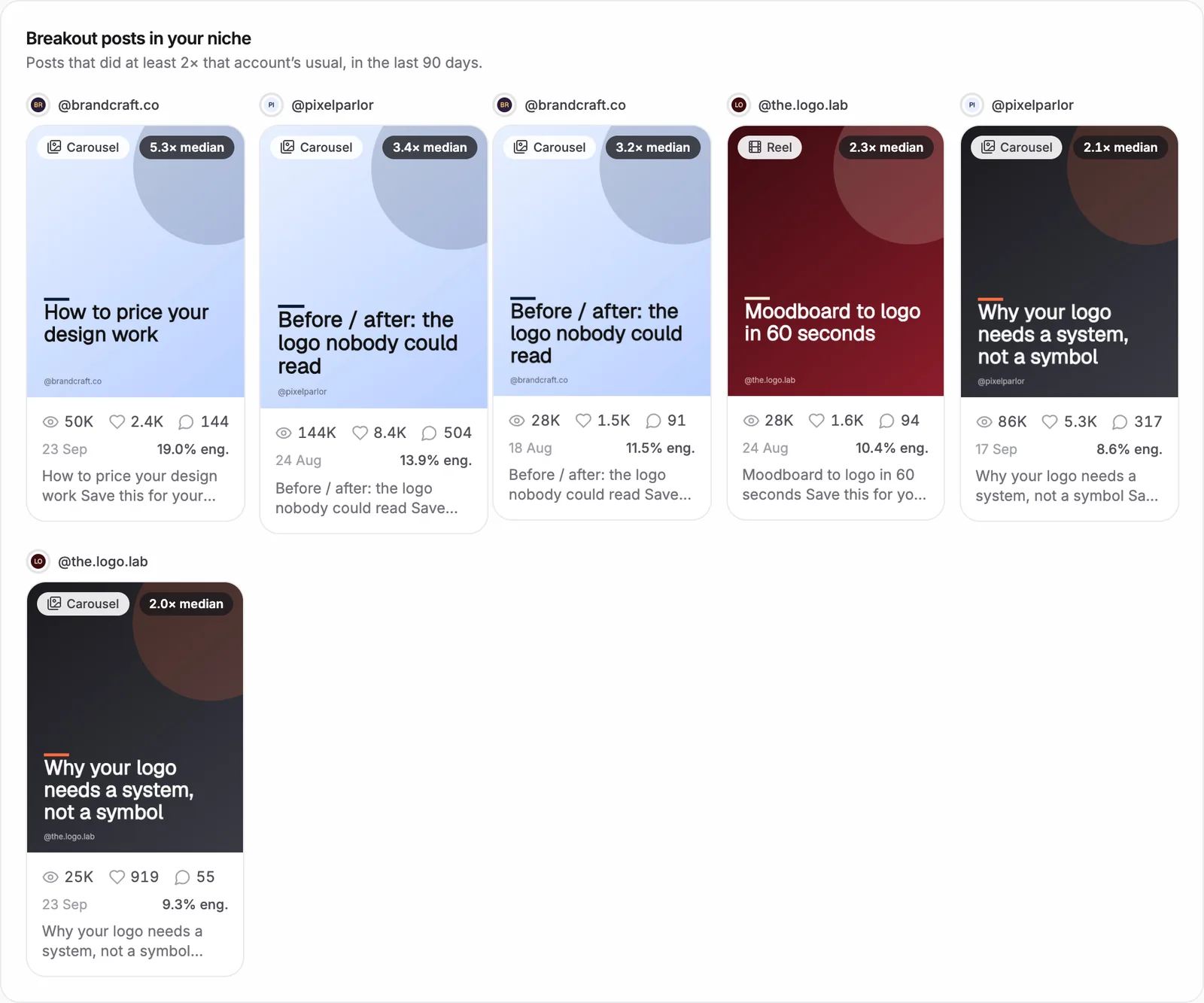
A breakout post is one that did at least 2× that account's median views. You find them by working out each account's usual and flagging anything well above it. This is the most important idea in this guide, because most of any account's posts are average. Studying the average teaches you nothing. Breakouts are where the audience clearly said "more of this".
Measuring against each account's own median also makes the comparison fair. A peer's Reel that jumped from 2K to 9K views is a stronger signal than a big account's Reel that went from 150K to 180K, even though the second number is bigger.
Doing this by hand across 10 accounts means opening every profile, writing down every view count and doing the maths every week. The agent does it at scale and as it happens: it watches every account you track, works out each one's median and flags new breakouts as they start beating their usual, so you see them while they're still fresh.
How Do You Spot Instagram Trends From Your Competitors?
You spot a trend when the same pattern breaks out for two or more accounts within a few weeks. One breakout can be luck: a good day, a share from a big account. The same hook, topic or format working for several accounts at once means the audience in your niche wants it right now.
Look back at my suggested accounts in step 2. Two different creators have the same idea near the top of their recent posts: Luke's "How to build Jarvis in a weekend" at 1.5M views, and Taki's "5 things to build in Claude in a weekend" at 118K, his best of the three recent posts shown. Different people, different audiences, same pattern: an ambitious build plus a short time frame. That's a trend signal, and it took one screen to see it.
What counts as a pattern worth tracking:
| Pattern type | What to look for | Example |
|---|---|---|
| Hook style | How the first line or first 3 seconds open | Result first, a question, a bold claim |
| Topic angle | The promise, not the subject | "Build X in a weekend" |
| Format | Reel, carousel or image, and its length | 30-second talking head Reels |
| Structure | How the middle of the post is built | Result shown first, then 3 numbered steps |
| Call to action | What viewers are asked to do | "Comment a keyword and I'll send it" |
Transcribe the Winners and Decode Why They Worked
To understand why a post worked, you need what was actually said, not just the caption. On Instagram most of the message in a Reel is spoken, so the caption only tells you half the story. The social media agent transcribes your competitors' most successful posts: the words spoken in the Reel, the text on screen and the caption. Now you can read a 1.5M-view Reel in 20 seconds instead of rewatching it ten times.
With the transcript in front of you, break it into five parts:
- Hook: the first line or first 3 seconds. Why would someone stop scrolling?
- Promise: what does the viewer get if they keep watching?
- Structure: how is the middle built? Steps, a story, a before and after, a list?
- Proof: what makes it believable? A demo, a number, a screenshot?
- Call to action: what are viewers asked to do at the end?
That breakdown is the pattern. The topic is theirs; the pattern is free to use. One habit I still keep: open the top breakout on Instagram and watch it once after reading the transcript. The transcript tells you what they said; watching it shows you the pace and the visuals.
How Do You Turn a Competitor's Post Into Your Own Content?
You keep the pattern and rebuild everything else from your own data: your best hook style, your audience's questions and your own results. This is where the agent does the part that would take you an hour. It takes the transcript of a competitor's winning post and creates a version of it for your account, using three things it already knows about you:
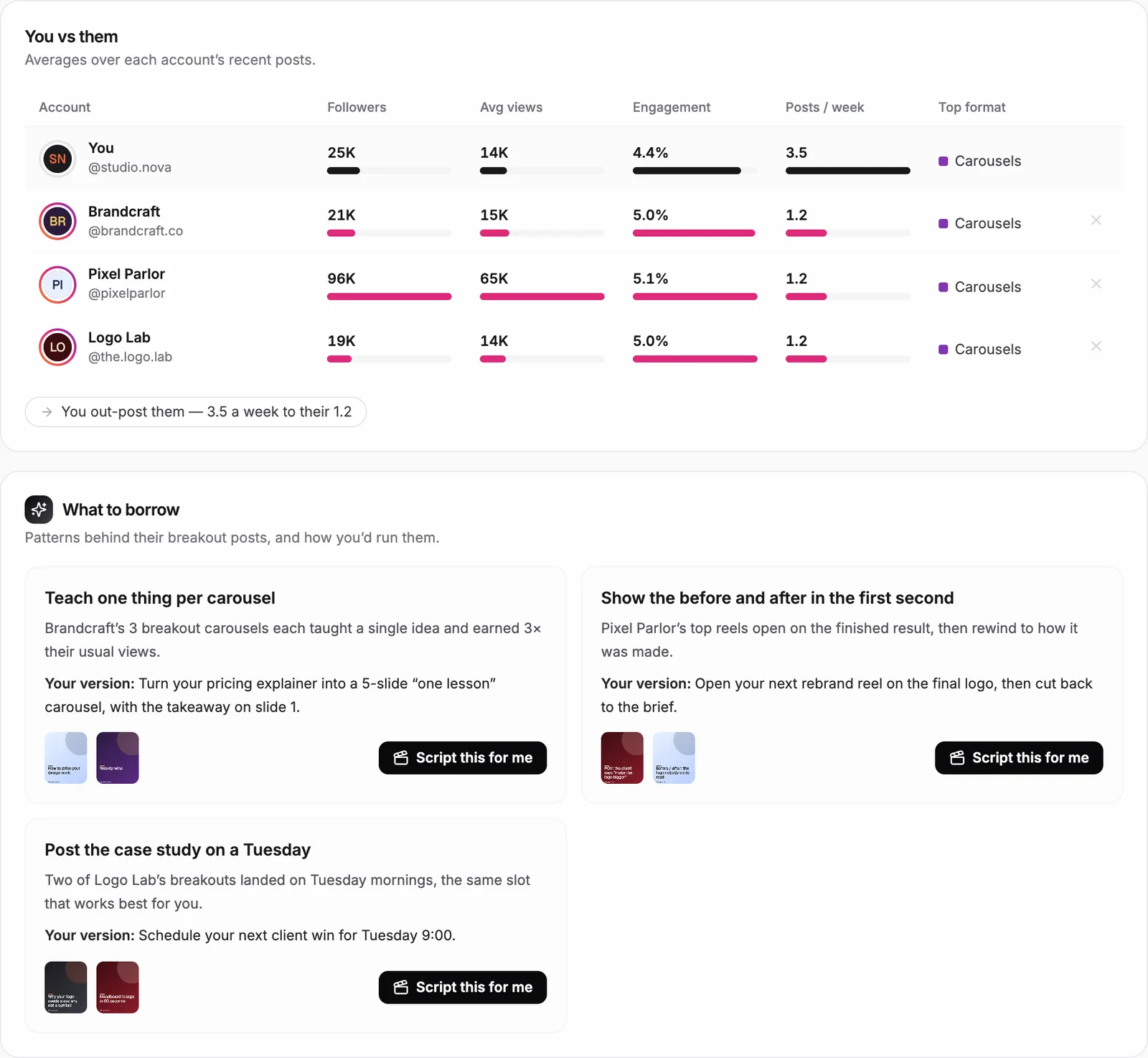
In the agent, the What to borrow cards turn breakouts into plays you can run this week, and Script this for me writes your version: hook options in your best style, a script to film and a caption. From there it goes into your content plan like any other post.
If you want the full journey from here (designing carousels in your brand kit and scheduling posts to Instagram automatically), that's in how to fully automate your Instagram with AI.
How to Spy on Competitors' Instagram for Free (the Manual Way)
You can run the same mission by hand with a spreadsheet and Claude. It takes one to two hours a week for five accounts instead of zero, but it costs nothing beyond your Claude plan.
- Open each competitor's profile and go to the Reels tab. Instagram shows the view count on every Reel in the grid.
- Log their last 20 posts in a sheet: date, format, views, likes, comments and the first line of the caption.
- For the posts that look well above their usual, turn on captions in the Reel and copy what's said into a transcript column.
- Check the Meta Ad Library too. It's free and shows every ad a competitor is running on Instagram and Facebook. Ads that keep running for months are the ones that make them money.
- Paste the sheet into Claude with the prompt below.
You are my Instagram competitor analyst. My account: @[your handle], niche: [your niche].
My audience: [who they are and what they want].
My best hook style so far: [e.g. result first, question, list]. My usual views per Reel: [number].

Below is a table of my competitors' last [20] posts per account:
account, date, format, views, likes, comments, first line of caption, transcript.

1. For each account, work out its median views. Flag every post with 2x that median or more
   as a "breakout" and rank all breakouts by how far they beat their own account's median.
2. Look across accounts. If the same topic, hook style or format broke out for 2 or more
   accounts in the last 30 days, list it as a trend and name the accounts.
3. For the top 3 breakouts, break the transcript into: hook (first line or first 3 seconds),
   promise, structure (how the middle is built), proof, and call to action.
   Tell me the pattern behind each one, not the topic.
4. Write my version of each: same pattern, my topic and my examples, opened in my best hook
   style. Give me 3 hook options, a 30-second script and a caption.

Only use the numbers in the table. If something can't be worked out from the data, say so.

[paste table here]
The catch: Claude can't open Instagram, it doesn't keep watching your competitors between sessions, and the transcripts are on you. That's fine for three accounts once a month. For 10 accounts every week, that's the gap the social media agent fills. If you'd rather build your own, start with how to build a social media AI agent.
What Are the Most Common Mistakes When Spying on Competitors?
Summary
Spying on your competitors' Instagram is the shortcut to content your audience already wants. Know your own baseline, track up to 10 peers and aspirational accounts, compare yourself on five public numbers, and only study the posts that broke out. When a pattern breaks out on more than one account, you've found a trend. Transcribe the winners, keep the pattern, and rebuild the post from your own hooks, audience and engagement data.
You don't need to reinvent the wheel. You need to notice which wheels are already turning, then build yours. For the bigger picture across every platform, read how to automate social media posting with an AI agent, or see how I turn this research into carousels and edited videos in how to grow on social media with Claude and an AI agent.
Frequently Asked Questions
Is it legal to spy on competitors' Instagram accounts?
Can competitors see that I'm tracking their Instagram?
How many competitors should I track on Instagram?
Can I see a competitor's Instagram insights, like reach and saves?
Won't copying competitors make my content generic?
How much does it cost to track competitors on Instagram?
Keep reading