How to Get Cited by ChatGPT, Perplexity and Claude: The 2026 Playbook

On this page
To get cited by ChatGPT, Perplexity and Claude, let their search crawlers read your site, get quoted in the articles they already cite for your buyers' questions, and publish pages that answer those questions in the first two sentences. Then support it with the technical basics: an llms.txt file, fast pages that don't depend on JavaScript, and clean metadata.
Most advice about AI search stops at your own website. But when a buyer asks “what's the best tool for this?”, ChatGPT, Perplexity and Claude often answer from roundups, review sites and comparison articles, and name the brands those articles mention. This playbook covers both halves: how to become one of those mentions, and how to make your own pages the source. It includes a check we ran this week of how many of the world's top websites publish an llms.txt file.
If you want the deep dive on crawlers, our guide on how to get cited by ChatGPT has our study of which AI crawlers the top 1,000 websites block.
How to get cited by ChatGPT, Perplexity and Claude in 8 steps
- Let all three in: allow OAI-SearchBot, PerplexityBot and Claude-SearchBot, and get indexed in Google and Bing.
- Get quoted in the articles AI already cites for your buyers' questions. This is the step most sites skip.
- Check who AI recommends ahead of you, the reasons it gives, and the sources behind them.
- Write pages AI wants to quote: a direct answer up top, question headings, facts and your own data.
- Publish an llms.txt file that sums up your business and links your best pages.
- Make pages fast and readable without JavaScript, so crawlers get the full text first time.
- Fill in your metadata: titles, descriptions, dates, author and structured data that match the page.
- Track the same questions every week across all three engines.
How Do ChatGPT, Perplexity and Claude Choose Which Sources to Cite?
All three search the web for the question, read the pages that come back, and cite the ones that answer it most clearly and credibly. So a page can only be cited if the engine's crawler can reach it and it shows up in the searches the engine runs. Where those searches come from differs a little between them:
| ChatGPT search | Perplexity | Claude | |
|---|---|---|---|
| Crawlers to allow | OAI-SearchBot, ChatGPT-User | PerplexityBot, Perplexity-User | Claude-SearchBot, Claude-User |
| Where its results come from | Its own crawler plus third-party search providers (Bing is widely reported) | Its own index, built by PerplexityBot | Web search, widely reported to draw on Brave Search |
| How it shows sources | Inline links and a Sources panel | Numbered sources on every answer | Inline citations with links |
| Training crawler (safe to block) | GPTBot | None separate | ClaudeBot |
Crawler names from OpenAI, Perplexity and Anthropic, checked November 2026.
The part that matters for strategy is what they cite. For a factual question (“how long does a website redesign take?”), the cited sources are often the brands and experts who answer it best. For a buying question (“best CRM for a small agency”), the sources are often third-party articles: roundups, review sites, comparison pages and forum threads. The engine then names the brands those articles mention. That gives you two routes in.
Can ChatGPT, Perplexity and Claude Reach Your Site?
Check before anything else, because a page their crawlers can't read is never cited, however good it is. Open yourdomain.com/robots.txt and make sure the search crawlers in the table above aren't disallowed by name or by a catch-all User-agent: * rule. Then check your CDN or firewall (Cloudflare, for example, has a setting that blocks AI bots), because those can block crawlers without touching robots.txt.
This robots.txt lets all three engines' search crawlers in:
# AI search: let these in so you can be cited
User-agent: OAI-SearchBot
User-agent: ChatGPT-User
User-agent: PerplexityBot
User-agent: Perplexity-User
User-agent: Claude-SearchBot
User-agent: Claude-User
Allow: /

# Everyone else, including Googlebot and Bingbot
User-agent: *
Disallow: /admin/

Sitemap: https://yourdomain.com/sitemap.xml
A crawler follows only the group that names it, so copy any private paths into the named group too. Then verify your site in Google Search Console and Bing Webmaster Tools and submit your sitemap to both. Our study of the top 1,000 websites found that 16.1% of them block at least one AI search crawler, so don't assume yours is open.
Why Does Getting Quoted in Articles AI Already Cites Matter So Much?
Because for buying questions, ChatGPT, Perplexity and Claude often recommend the brands named in the articles they cite, not the brands with the best website. If a “best project management tools for agencies” roundup is cited in most answers to that question and you aren't in it, you are missing from the answer. Get into that article and you can be named in the answer straight away, even before your own page ranks.
It also has three side effects that help route A:
- The article already ranks. You borrow its position instead of waiting months to earn your own.
- It counts across engines. The same roundup is often cited by ChatGPT, Perplexity and Claude, so one mention can show up in all three.
- It builds trust in your brand as an entity. The more independent sites describe you consistently, the more confidently an AI describes you too.
How do you find the articles AI cites for your topic?
Write down 10 to 20 questions your buyers really ask (“best [product] for [type of business]”, “[competitor] alternatives”, “[competitor A] vs [competitor B]”). Ask each one in ChatGPT, Perplexity and Claude with web search on, and copy every cited source into a sheet with the question, the engine and the brands it mentions. Run each question two or three times on different days, because answers vary. Then sort by how often each URL appears. The pages cited again and again, by more than one engine, are your shortlist.
How do you get quoted in those articles?
Give the author a reason to include you that makes their article better. What that reason is depends on the type of page:
| Type of cited page | How to get in |
|---|---|
| “Best X for Y” roundups | Email the author with the one thing you do best for that audience, a free account to test, and a fact or customer result they can quote. |
| Comparison and “X vs Y” articles | Send an accurate, dated feature and pricing sheet, and point out anything about you that's out of date. Authors like corrections that keep them right. |
| Review sites (G2, Capterra, Trustpilot, Google) | Ask happy customers for reviews that name the use case (“great for small agencies”), since AI often repeats those phrases. |
| Reddit and forum threads | Answer the question honestly, say who you are, and only mention your product where it really fits. Spam gets removed and remembered. |
| Industry news and data roundups | Publish original data (a survey, a study, your own numbers) and share it with the journalists who cover your space. |
| YouTube reviews and tutorials | Offer creators early access or a walkthrough. Perplexity and Google's AI features regularly cite videos. |
Start with the three or four URLs cited most, because one mention there is worth more than ten on pages AI never reads. Keep your pitch short, and make it about their readers rather than your launch.
Who Is AI Recommending Ahead of You, and Why?
Ask the engines your buyers' questions and write down which brands they recommend, in what order, the reasons they give, and the sources behind each reason. That tells you exactly what to fix. If ChatGPT recommends a competitor “because it has a free plan and integrates with QuickBooks”, and you have both, the problem is that no source it reads says so about you yet.
The reasons usually fall into one of four gaps:
- A source gap: competitors are in the articles AI cites and you aren't. Fix it with step 2.
- A page gap: no page of yours answers the question. Write it (step 4).
- A fact gap: you have the feature, price or result, but it isn't written anywhere a crawler can read. Publish it on your site and in your llms.txt.
- A trust gap: competitors have more reviews, more mentions and more data. That takes longer, so start now.
Copy this prompt into ChatGPT or Claude with web search on, fill in the brackets, and run it once a month:
You are an AI search analyst for [Business Name] ([yourdomain.com]). We sell [product or service] to [audience] in [location, if local].

GOAL
Find out who AI search recommends ahead of us, why, and which sources those recommendations come from.

QUESTIONS
[Paste 10 to 20 questions your buyers ask, for example:
"What is the best [product] for a [type of business]?"
"[Competitor] vs [another competitor]: which is better for [use case]?"
"What should I look for in a [product] if I [situation]?"]

STEPS
1. Search the web for each question and write the answer a buyer would get.
2. List every brand you recommend, in order, and the reason you give for each.
3. List every source you used: the URL, the type of page (brand site, roundup, review site, forum, news, video) and which brands it mentions.
4. Note whether [Business Name] is recommended, mentioned or missing.

THEN
5. Make a table of the sources that appear for more than one question, with the brands each one mentions and whether we are in it.
6. For the 3 competitors recommended most, sum up the reasons AI gives for picking them and the evidence behind each reason.
7. Give the 5 actions most likely to get us recommended: articles to get quoted in, pages to write or fix, and facts we should publish.

RULES
- Only report sources you actually found. Never invent URLs, brands or quotes.
- If you can't search the web, stop and say so.
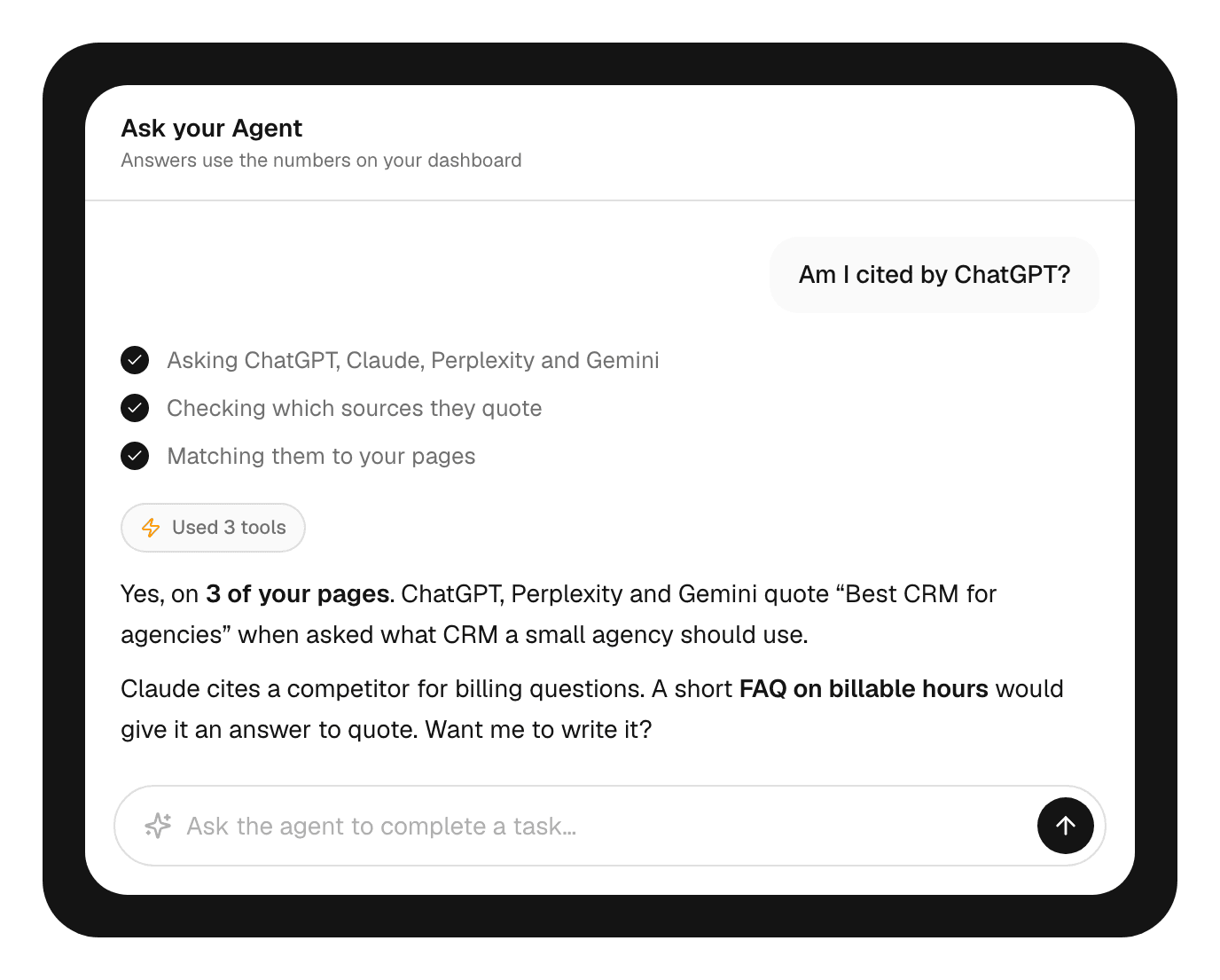
The SEO & GEO agent runs this review for you every week. It shows which brands each engine recommends for your questions, the reasons it gives and the sources behind them, then turns each gap into a job: an article to get quoted in, a page to write, or a fact to publish.
How Do You Write a Page AI Wants to Quote?
Answer the question in the first 40 to 60 words, in a passage that makes sense on its own, then give each follow-up question its own heading with the answer in the first sentence underneath. AI engines lift short, complete passages. A page that warms up for three paragraphs gives them nothing to quote.
- Question headings: “How much does an agency CRM cost?”, not “Pricing”.
- Facts with dates and sources: prices, numbers and claims an engine can check. In the paper that coined the term GEO, Aggarwal et al. (KDD 2024) found adding statistics, quotes and citations could lift a source's visibility in AI answers by up to 40%.
- Original data: something only you can publish, so anyone quoting it has to cite you.
- Tables and lists as real text, never inside images.
- Honest comparisons, including where a competitor is the better fit. Engines avoid citing pure sales pages.
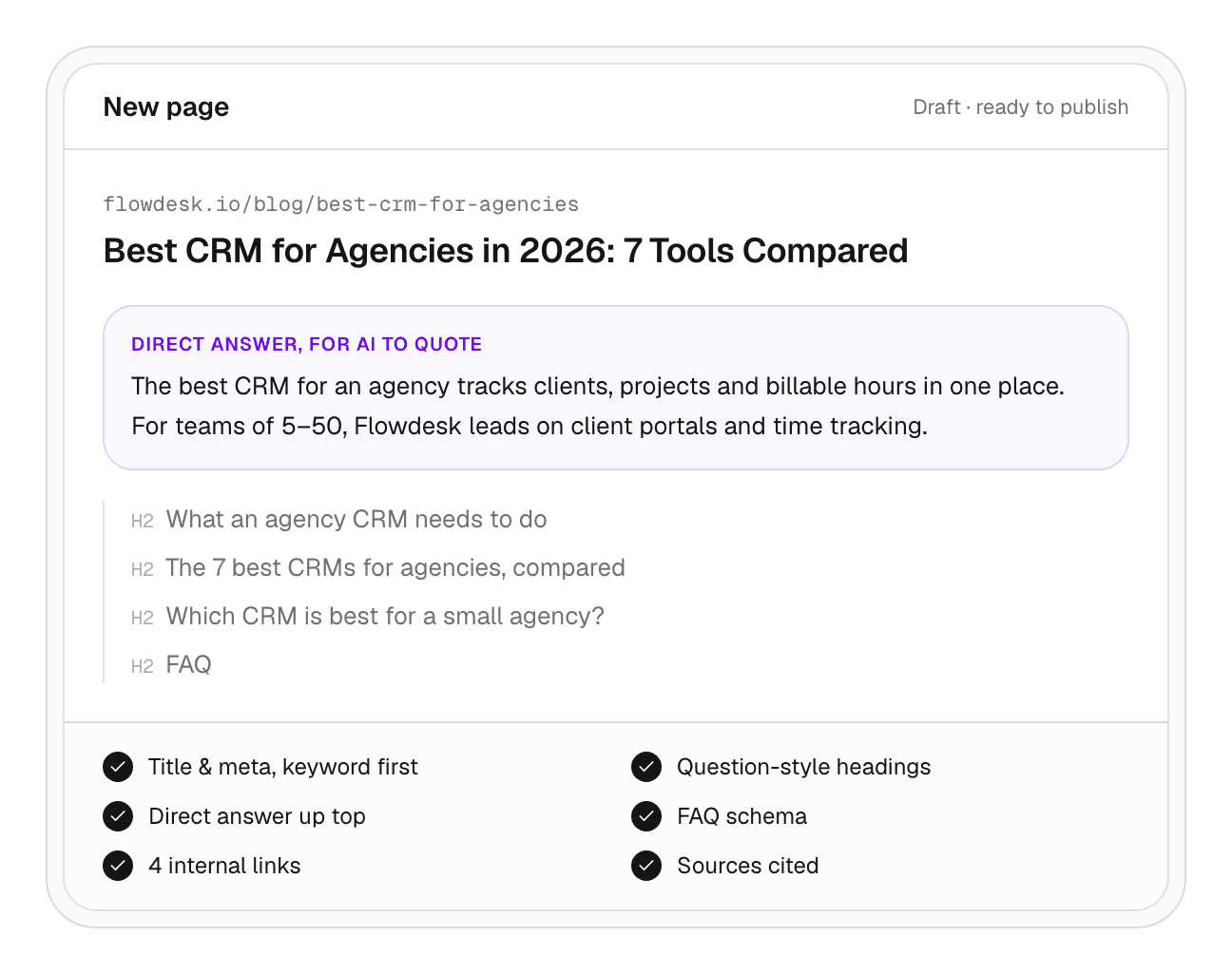
To find which questions to write for in the first place, our guide to automating keyword research for GEO turns your Search Console data into the prompts buyers type into AI.
Should You Add an llms.txt File?
Yes, as long as you see it as a cheap helper and not a ranking switch. An llms.txt is a plain Markdown file at yourdomain.com/llms.txt that tells AI tools what your business does and links your most important pages, so a model or agent can understand your site without crawling all of it. It was proposed by Jeremy Howard of Answer.AI in September 2024.
Be clear about its limits. No major AI search engine has said it uses llms.txt to choose citations, and Google says you don't need AI text files or special markup for its AI features. What it does well is give any AI that reads it a correct, current summary of you, in your words: your products, prices, audience and best guides. That helps with the “fact gap” from step 3.
How many top websites publish an llms.txt? (Our November 2026 check)
22.1% of the world's top websites publish an llms.txt file, and 3.8% also publish the longer llms-full.txt. We checked the same 479 sites from our robots.txt study (the Tranco top 1,000 domains that publish robots.txt rules and allow Googlebot) on 13 November 2026.
- Software and infrastructure companies lead. Cloudflare, GitHub, Stripe, Shopify, HubSpot, Slack, Zendesk, Dropbox and Calendly all publish one.
- Publishers are joining too. Fox News, Business Insider, Time and Weather.com serve one, though Time's is a usage policy rather than a site map.
- The very biggest sites lag. Only 6 of the 46 sites in the top 100 publish one (13.0%), against 22.1% overall.
- Four sites send mixed signals. Bloomberg, the Daily Mail (both domains) and La Repubblica publish an llms.txt but block at least one AI search crawler in robots.txt.
Method: we requested https://domain/llms.txt, then https://www.domain/llms.txt, and counted a site if it returned a 200 response with a text file that starts with a Markdown heading, not an HTML page. Limits: some sites serve different responses to different visitors (Bloomberg's file did not appear for every request we made), so treat these numbers as a snapshot. Download the results (CSV, 479 sites). You're welcome to use the data with a link to this page.
What should your llms.txt include?
Keep it short and factual. This template covers what most small businesses need:
# [Your Business Name]

> [One or two sentences: what you sell, who it's for and where you operate.
> Write it the way you'd want an AI to describe you.]

## Products and services
- [Product or service](https://yourdomain.com/product): what it does, who it's for, price from
- [Pricing](https://yourdomain.com/pricing): plans and what each includes

## Guides
- [Your best guide](https://yourdomain.com/blog/guide): the question it answers

## Company
- [About](https://yourdomain.com/about): who you are, founded, location
- [Customer reviews](https://yourdomain.com/reviews)
- [Contact](https://yourdomain.com/contact)
Serve it as plain text at the root of your domain and keep it up to date, since an out-of-date price in your llms.txt is worse than none. We generate our own llms.txt from the same list that builds our blog, so every new guide is added the moment it's published.
Does Page Speed Affect Whether AI Cites You?
Yes, in two ways. When ChatGPT, Perplexity or Claude opens your page during an answer, it does so while the user waits, so a page that is slow to respond risks being skipped for a faster one. And speed is part of how Google ranks pages, which is where AI answers find many of their candidates.
The bigger issue is often JavaScript, not raw speed. When Vercel analysed crawler traffic across its network, it found that none of the major AI crawlers it tracked ran JavaScript, including OpenAI's and Anthropic's. They read the HTML your server sends and stop.
Aim for these, and test with Google's PageSpeed Insights:
| Check | Target | Why it matters for AI |
|---|---|---|
| Main content in the raw HTML | The answer visible in “view source” | Most AI crawlers don't run JavaScript |
| Time to first byte (TTFB) | 0.8 seconds or less | Live fetches happen while the user waits |
| Largest Contentful Paint (LCP) | 2.5 seconds or less | A Core Web Vital that feeds Google rankings |
| No content behind pop-ups or logins | Answer readable without clicking | Crawlers can't close a cookie wall or sign in |
| Page weight | Compressed images, few scripts | Lighter pages respond and render faster |
Our guide on how to make your website faster walks through the fixes that make the biggest difference.
Which Metadata Helps AI Understand Your Pages?
A clear title, an accurate meta description, a canonical URL, visible publish and update dates, a named author, and structured data that describes the page and your business. None of it is AI-only; it's the same metadata Google uses, and it helps every engine work out what a page is about, who wrote it and whether it's current.
| Metadata | What it tells AI search |
|---|---|
| Title tag | The question the page answers. Lead with it, keep it under 60 characters. |
| Meta description | A one-sentence summary that search results, and often the engines, show. |
| Canonical URL | Which version of the page to cite when there are duplicates. |
| datePublished and dateModified | That the facts are current. Show the updated date on the page too. |
| Author with a profile link | Who stands behind the claims, and their expertise. |
| Organization schema with sameAs | That your site, LinkedIn, review profiles and listings are the same business. |
| FAQ, Product or HowTo schema | The structure of the answer, as long as it matches the visible text. |
Here is what that looks like in a page's head:
<title>Best CRM for Small Agencies (2026): 7 Picks Compared</title>
<meta name="description" content="The best CRM for a small agency in 2026, compared on price, client portals and time tracking. Updated monthly." />
<link rel="canonical" href="https://yourdomain.com/best-crm-for-agencies" />
<meta property="og:title" content="Best CRM for Small Agencies (2026)" />
<meta property="og:image" content="https://yourdomain.com/og/best-crm.png" />

<script type="application/ld+json">
{
  "@context": "https://schema.org",
  "@type": "Article",
  "headline": "Best CRM for Small Agencies (2026): 7 Picks Compared",
  "datePublished": "2026-03-02",
  "dateModified": "2026-11-10",
  "author": { "@type": "Person", "name": "Your Name", "url": "https://yourdomain.com/about" },
  "publisher": {
    "@type": "Organization",
    "name": "Your Business",
    "url": "https://yourdomain.com",
    "sameAs": ["https://www.linkedin.com/company/your-business", "https://www.g2.com/products/your-product"]
  }
}
</script>
Two rules keep it working. First, the structured data must match what's on the page; Google ignores, and can penalise, markup that describes content nobody can see. Second, only change dateModified when the content really changes. Bumping the date without updating anything is easy to spot and erodes trust.
How Do You Track Whether ChatGPT, Perplexity and Claude Cite You?
Keep a fixed list of 20 or so buyer questions and check them in all three engines every week, recording whether you are cited, mentioned or missing, and who is cited instead. Twenty questions checked weekly tells you far more than two hundred checked once, because AI answers change from one run to the next.
For traffic, look for referrals from chatgpt.com, perplexity.ai and claude.ai in your analytics. Many citations never produce a click, though, so the weekly check is the real measure. Our SEO & GEO agent tracks this alongside your Google rankings, and our guide to automating SEO and GEO with an AI agent shows how to build a version of that loop yourself.
Summary
ChatGPT, Perplexity and Claude cite pages they can reach, that show up in their searches, and that answer the question clearly with evidence. For buying questions they lean heavily on third-party articles, so the fastest way into the answer is often to be quoted in the roundups, reviews and comparisons they already cite, while your own pages catch up.
So the order is: let OAI-SearchBot, PerplexityBot and Claude-SearchBot in; find the articles AI cites and get into them; check who AI recommends ahead of you and why; write pages built to be quoted; and back it all with an llms.txt file, fast server-rendered pages and honest metadata. Then check the same questions every week.
Frequently Asked Questions
How do I get cited by ChatGPT, Perplexity and Claude?
How do I get Perplexity to cite my website?
How do I get Claude to cite my website?
Does an llms.txt file help you get cited by AI?
Does page speed affect AI citations?
How do I find the articles ChatGPT cites for my topic?
Can I pay to be featured in the articles AI cites?
How long does it take to get cited by AI search?
Keep reading
Related guides
SEO & GEO Automation
How to Get Cited by ChatGPT and AI Search: 9 Steps, Plus Data From the Top 1,000 Websites
SEO & GEO Automation
How to Automate Keyword Research for GEO (Generative Engine Optimization), Step by Step
SEO & GEO Automation