How to Get Cited by ChatGPT and AI Search: 9 Steps, Plus Data From the Top 1,000 Websites

On this page
To get cited by ChatGPT and other AI search tools, let their search crawlers reach your site, rank in normal search for the question, and write pages that answer it in the first two sentences, backed by facts, sources and your own data. AI answer engines quote pages they can crawl, that already rank, and that make a clear, trustworthy answer easy to lift.
This guide covers how ChatGPT, Claude, Perplexity, Gemini and Google's AI Overviews choose their sources, the nine steps we follow to get pages cited, and a study we ran this month of which AI crawlers the world's top 1,000 websites let in. One finding surprised us: about 1 in 6 of the biggest sites block at least one AI search engine from reading them, which leaves the citations to everyone else.
How to get cited by ChatGPT and AI search in 9 steps
- Let the AI search crawlers in: OAI-SearchBot, Claude-SearchBot and PerplexityBot, in robots.txt and in your firewall or CDN.
- Get indexed and ranking in Google and Bing, because AI answers pick from pages that rank.
- Find the questions your buyers ask AI, not just the keywords they type into Google.
- Answer in the first two sentences of the page, in words an AI could quote on their own.
- Use question-style headings, one question per section, each answered in its first sentence.
- Add facts, sources and your own data, with dates and links.
- Use tables, lists and FAQs as real HTML text, with structured data that matches the page.
- Get mentioned on other sites that AI answers already cite: reviews, comparisons, forums and press.
- Update and track: refresh pages that slip and check the same questions every week.
How Does ChatGPT Decide Which Websites to Cite?
ChatGPT cites pages it found by searching the web for your question, so it can only cite pages its search crawler can reach and that rank for the searches it runs. When a question needs fresh or specific information, ChatGPT search, Perplexity, Claude and Google's AI features run one or more web searches, read the best results and write an answer that links to the pages they used.
Google calls the multiple-search step query fan-out: its AI Overviews and AI Mode may issue several related searches across subtopics to build one answer. That is why a single page can be cited for questions it never mentions word for word, and why pages that each answer one sub-question clearly get picked so often.
Three things follow from how this works:
- Access comes first. A page the search crawler can't read is never a candidate.
- Rankings still matter. The candidates come from search results, so classic SEO is the entry ticket. Google says there are no special requirements for its AI features beyond being indexed and eligible for a snippet.
- Clarity wins the citation. Among the candidates, the engine quotes the pages whose answer is easiest to lift and best supported.
Do Websites Block AI Search Crawlers? (Our Study of the Top 1,000 Websites)
Yes. In our October 2026 study, 16.1% of the world's top websites block at least one AI search crawler in their robots.txt file, and 9.8% block ChatGPT's search crawler, OAI-SearchBot. Every site that does this has taken itself out of those answers, whatever the quality of its content.
We took the 1,000 most popular domains in the Tranco research ranking, downloaded each site's robots.txt on 20 October 2026, and checked which crawlers each file lets in. We kept the 479 sites that publish robots.txt rules and allow Googlebot, so every site in the sample wants to be found in search.
| Crawler | What it's for | If you block it | Top sites blocking |
|---|---|---|---|
| OAI-SearchBot | ChatGPT search | Not shown in ChatGPT search answers | 9.8% |
| GPTBot | OpenAI model training | Content not used to train OpenAI models; no effect on ChatGPT search | 19.2% |
| Claude-SearchBot | Claude search | Less visible in Claude's search answers | 11.1% |
| ClaudeBot | Anthropic model training | Content left out of future training data | 19.8% |
| PerplexityBot | Perplexity's search index | Less visible in Perplexity answers | 15.4% |
| Google-Extended | Gemini training and grounding | Not used by Gemini; no effect on Google Search or AI Overviews | 16.7% |
| Googlebot | Google Search, AI Overviews and AI Mode | Gone from Google entirely | n/a (all sites in the sample allow it) |
Sources for what each crawler does: OpenAI, Anthropic, Perplexity and Google, checked October 2026.
What the study found
- Training crawlers are blocked about twice as often as search crawlers. 19.2% block GPTBot, but 9.8% block OAI-SearchBot.
- Half of the sites that block GPTBot still allow ChatGPT search. 45 of the 92 sites blocking OpenAI's training crawler leave OAI-SearchBot in, so they stay citable without giving up their content for training.
- Some of the biggest names are out of ChatGPT search answers. Amazon, The New York Times, the BBC, CNN, Bloomberg, Facebook, Instagram and Pinterest all block OAI-SearchBot, either by name or with a catch-all rule.
- Classic search is almost never blocked. Only 3 of the 479 sites block Bingbot, against 47 blocking ChatGPT's search crawler.
For a smaller business, the takeaway is practical. Every big site that shuts out an AI search crawler is one fewer source competing for the citation in that engine. If your own robots.txt or CDN is doing the same by accident, you are giving those citations away.
How we ran the study
Sample: the top 1,000 domains of Tranco list GQG5K (generated 19 October 2026). We requested https://domain/robots.txt, then https://www.domain/robots.txt, on 20 October 2026. 506 domains returned a robots.txt file with rules; many of the rest are infrastructure domains with no website. Of the 506, the 479 that allow Googlebot form the sample. Each file was evaluated with the rules of the robots.txt standard (RFC 9309): a crawler follows the group that names it, or the catch-all group if none does, and a site counts as blocking a crawler if a typical article URL is disallowed for it. Limits: robots.txt is only one way to block a crawler (firewalls and CDNs can block without it), so these numbers are a floor, and some sites serve different files to different visitors. Download the full results (CSV, 479 sites). You're welcome to use the data with a link to this page.
How to Get Cited by ChatGPT, Step by Step
These are the nine steps we follow for every page we want AI search to quote. The first two decide whether a page can be cited at all; the rest decide whether it will be.
Step 1: Let the AI search crawlers in
Open yourdomain.com/robots.txt and check that OAI-SearchBot, Claude-SearchBot, PerplexityBot, Googlebot and Bingbot are not disallowed, either by name or by a catch-all User-agent: * rule. Then check your CDN or firewall: some hosting and security settings block AI crawlers without touching robots.txt. Google lists this exact check, including "through any CDN or hosting provider", in its guidance for AI features.
If you want AI search but not AI training, a robots.txt like this does both:
# Let AI search engines find and cite your pages
User-agent: OAI-SearchBot
User-agent: Claude-SearchBot
User-agent: PerplexityBot
Disallow: /admin/

# Optional: opt out of AI model training
User-agent: GPTBot
User-agent: ClaudeBot
User-agent: CCBot
Disallow: /

# Everyone else, including Googlebot and Bingbot
User-agent: *
Disallow: /admin/

Sitemap: https://yourdomain.com/sitemap.xml
One detail catches a lot of sites out: a crawler follows only the group that names it. Once you add a group for OAI-SearchBot, it ignores your User-agent: * rules, so copy any paths you want kept private (like /admin/ above) into the named group too. We left Google-Extended out of the training block on purpose, because Google says it also controls grounding in other Google AI products such as Gemini, which cite sources of their own. OpenAI says robots.txt changes take about 24 hours to reach ChatGPT search.
Step 2: Get indexed and ranking in Google and Bing
Verify your site in Google Search Console and Bing Webmaster Tools, submit your sitemap to both, and fix any pages that aren't indexed. AI answers draw their candidates from search results, so a page on page five for every search it could match rarely gets cited. OpenAI has said ChatGPT search uses third-party search providers alongside its own crawler, and Bing is widely reported to be one of them, so Bing Webmaster Tools is worth the ten minutes it takes.
Step 3: Find the questions your buyers ask AI
People ask AI tools full questions with context ("what's the best CRM for a 10-person agency on a small budget?"), not two-word keywords. Start from the question queries in your Search Console data, rewrite them as the prompts different buyers would type, and check who gets cited for each today. Our guide to automating keyword research for GEO walks through this step by step, with a prompt that does it for you.
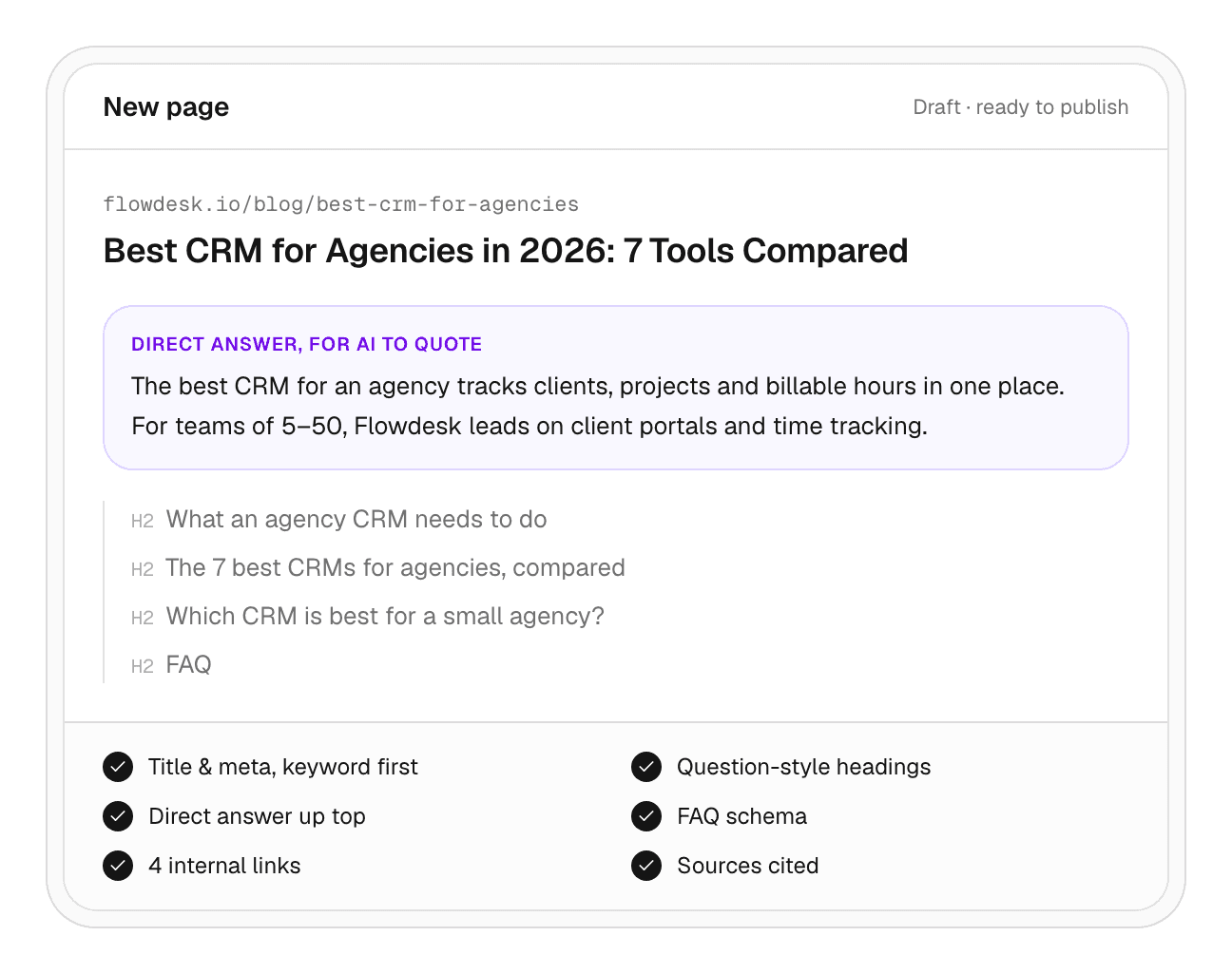
Step 4: Answer the question in the first two sentences
Put a 40 to 60 word answer at the very top of the page, written so it still makes sense if it is the only part someone reads. AI engines lift short, complete passages. A page that spends three paragraphs warming up before it answers gives them nothing to quote, even if the answer further down is better than anyone else's.
Step 5: Use question-style headings, one question per section
Phrase each H2 as a question people actually ask ("How much does an agency CRM cost?", not "Pricing") and answer it in the first sentence underneath. Each section then works as a standalone answer to one of the fan-out searches, which is exactly the unit an AI engine is looking for. Keep one idea per section; a heading that covers three questions answers none of them cleanly.
Step 6: Add facts, sources and your own data
Back every claim with a number, a named source or something you measured, and date it. In the research paper that coined the term GEO, Aggarwal et al. (KDD 2024) found that content changes like these could boost a source's visibility in generative engine answers by up to 40%. Original data works best of all, because it gives the engine something it can only get from you. The study in this post is an example: anyone who wants to quote how many sites block AI crawlers has to cite its source.
Step 7: Use tables, lists and FAQs as real text
Comparisons belong in HTML tables, processes in numbered lists, and common follow-up questions in an FAQ section. All of it must be real text on the page, not text inside an image, so a crawler can read it. Add structured data such as FAQ markup where it fits, but treat it as a description of the page, not a shortcut: Google says structured data has to match the visible text, and that no special schema is needed for its AI features.
Step 8: Get mentioned on the sites AI already cites
AI answers often cite third-party pages, such as comparison articles, review sites, forum threads and industry lists, alongside or instead of brand websites. Run your buyers' questions, note which outside pages get cited, and work on being included in them: ask happy customers for reviews, pitch the authors of comparison articles, answer questions in the communities your buyers use, and share your original data with the people who write about your industry.
Step 9: Update pages and track the same questions every week
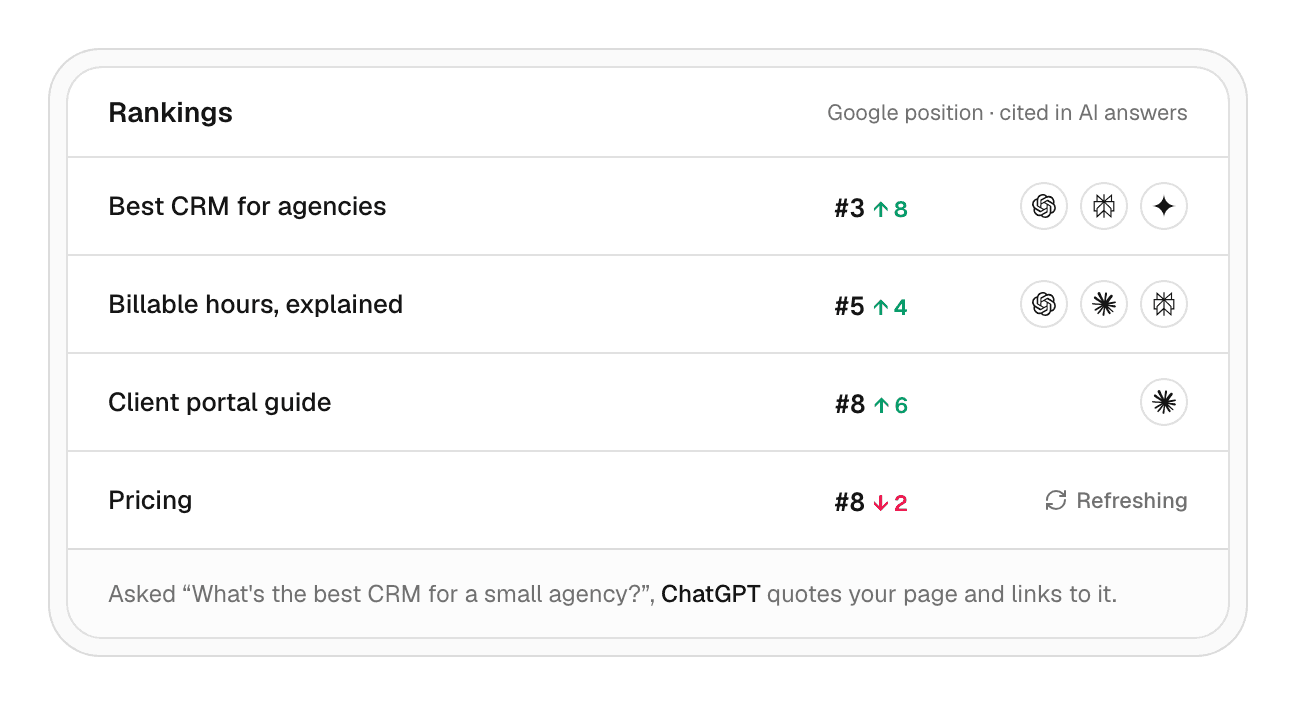
Refresh the pages that matter on a schedule: update the numbers, add what has changed, and show the date it was updated. Then re-check the same set of questions every week. AI answers change from one run to the next, so a single check is a snapshot; the weekly trend is what tells you whether a change worked.
How Do You Check If ChatGPT Cites Your Website?
Ask ChatGPT, Perplexity, Claude and Gemini the questions your buyers ask, with web search on, and record which sources each one cites. Do it from a logged-out or fresh session where you can, because personalisation can change answers. Twenty questions checked every week tells you far more than two hundred checked once.
You can hand most of the work to an AI tool with web search. Copy this prompt, fill in the brackets, and run it in ChatGPT or Claude:
You are an AI visibility analyst for [Business Name] ([yourdomain.com]), which sells [product or service] to [audience].

GOAL
Find out whether AI search tools cite us for the questions our buyers ask, who they cite instead, and what to fix first.

QUESTIONS
[Paste 10 to 20 questions your buyers ask, for example "What is the best [product] for a small [type of business]?"]

STEPS
1. For each question, search the web and list the 3 to 5 sources you would cite in a good answer.
2. Note whether [yourdomain.com] is one of them, and which page.
3. For every source cited instead of us, say why it was picked: a direct answer in its first lines, original data, a comparison table, a recent update, a trusted third-party site, or a heading that matches the question.
4. Sort the questions into three groups: cited, close (we have a page but it isn't cited) and missing (we have no page that answers it).

RULES
- Only report sources you actually found. Never guess or invent URLs.
- If you can't search the web, stop and say so.

OUTPUT
A table with: question, cited (yes or no), who is cited instead, why, and the one change most likely to get us cited.
Then the top 3 pages to write or fix, in order.
For traffic rather than citations, two places help. Google counts clicks from AI Overviews and AI Mode inside the normal Web search type in Search Console; it doesn't split them out. Visits from ChatGPT, Perplexity, Claude and Gemini usually appear as referrals from their domains in your analytics, such as chatgpt.com and perplexity.ai.
How Do You Automate GEO With an AI Agent?
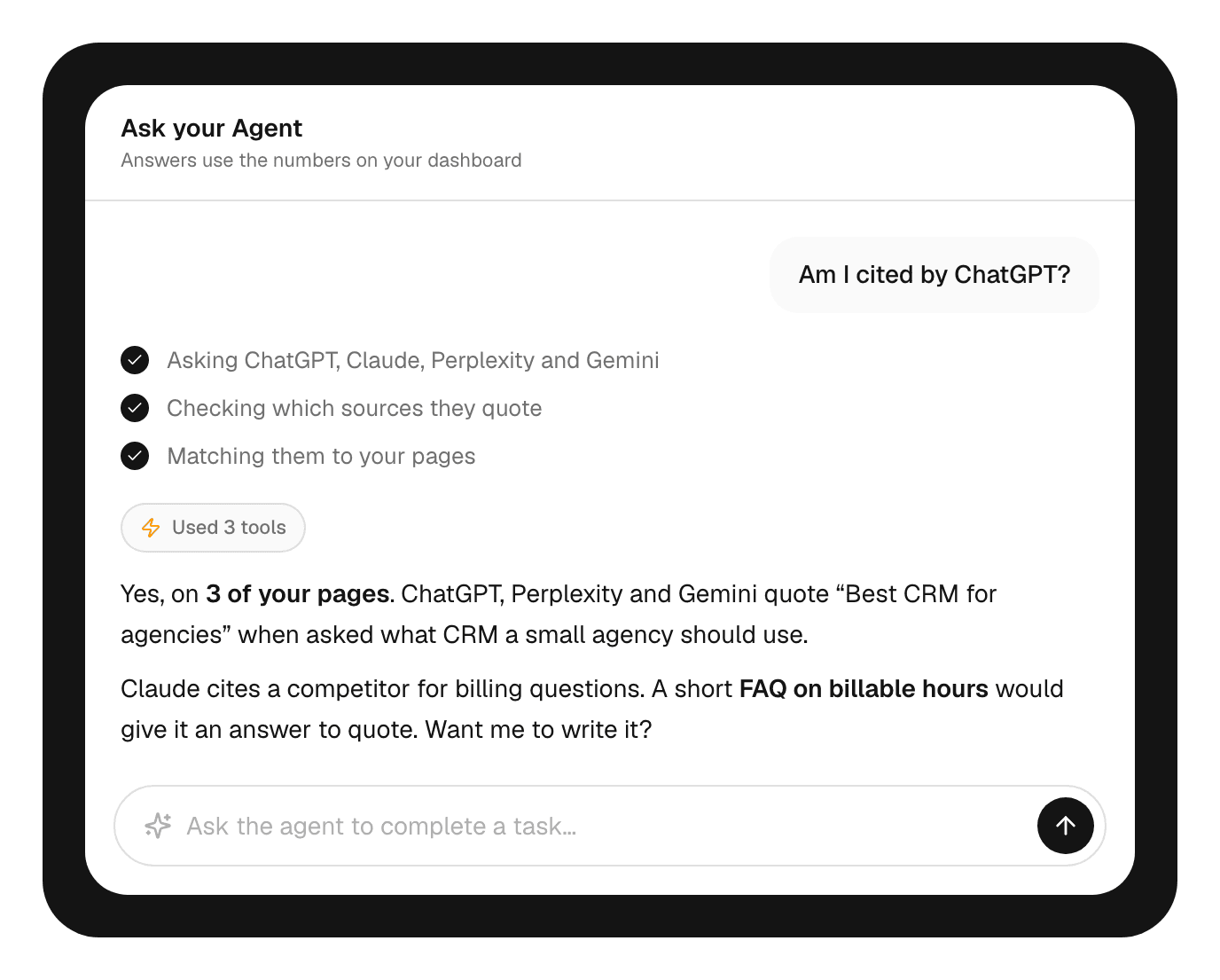
An AI agent can run the whole loop on a schedule: read your Search Console data, find the questions you can win, write or refresh pages built to be quoted, publish them, and check every week which AI tools cite each page. That is what our SEO & GEO agent does, and the guide to automating SEO and GEO with an AI agent shows how to build a version yourself.
What Doesn't Help You Get Cited by AI?
Some popular GEO advice does little or nothing. Skip these, or at least don't expect them to move citations:
- An llms.txt file on its own. Google says you don't need new machine-readable files or "AI text files" for its AI features. We publish one because it's cheap, but it's not why pages get cited.
- Special schema for AI. There is no AI-only markup. Normal structured data that matches the page is enough.
- Blocking GPTBot to "protect" content and expecting citations to drop, or to rise. GPTBot only covers training. Citations in ChatGPT depend on OAI-SearchBot.
- Hundreds of thin AI-written pages. Pages that don't rank never become candidates, and pages with nothing new give an engine no reason to quote them.
- Writing for the AI instead of the reader. The pages that get quoted are the ones that answer a real person's question best. Keyword lists and robotic phrasing help neither.
Summary
AI search engines cite pages they can crawl, that rank for the searches they run, and that answer the question clearly with evidence. So the work is in that order: let OAI-SearchBot, Claude-SearchBot and PerplexityBot in, get indexed and ranking in Google and Bing, then make every page quotable with a direct answer, question headings, facts, sources and your own data, and get mentioned on the sites AI already trusts.
Our study of the top 1,000 websites shows how much room there is: about 1 in 6 of them block at least one AI search crawler, and half of the sites that block OpenAI's training crawler still let ChatGPT search in. Check your own robots.txt today; it's the fastest GEO win there is.
Frequently Asked Questions
How do I get my website cited by ChatGPT?
Does blocking GPTBot stop ChatGPT from citing my site?
Is GEO different from SEO?
How long does it take to get cited by AI search?
Do I need an llms.txt file or special schema to get cited?
How can I tell if ChatGPT or Google AI Overviews send me traffic?
Can I pay to be cited by ChatGPT?
Keep reading
Related guides
SEO & GEO Automation
How to Automate Keyword Research for GEO (Generative Engine Optimization), Step by Step
SEO & GEO Automation
How to Automate SEO (and GEO) With an AI Agent
AI Agents